
If Hua Hin was the gentle landing, Sisaket was the heart of the trip.
When we planned this anniversary journey, we knew we wanted more than resorts and sky bars. We wanted a chapter that would stay with us — and Part Two took us east into Isan, Thailand’s northeastern region, to a small village called Ban Bua Noi, “Small Lotus Village,” where one of our dearest friends grew up. She was spending the summer there with her husband and son, visiting her family, and she invited us to come see the Thailand that doesn’t appear in glossy brochures. We said yes before she finished the sentence.
Getting There: Bangkok to Ubon
We caught a late-afternoon AirAsia flight out of Bangkok’s Don Mueang airport, and just seventy-five minutes later we touched down at Ubon Ratchathani, the gateway airport for this corner of the country. The change was immediate and wonderful. Gone were the high-rises and the tour buses. In their place: rice paddies stretching to the horizon, water buffalo unbothered by anything, and a slower rhythm that settles into you before you’ve even left the parking lot.
We based ourselves at the Centara Ubon for two nights — a comfortable, modern hotel with a pool-view room that gave us a cool, quiet retreat at the end of each full day. It made an easy launch point for the drive out to the village.
A Day in Ban Bua Noi
Some days on a trip blur together. This one never will.
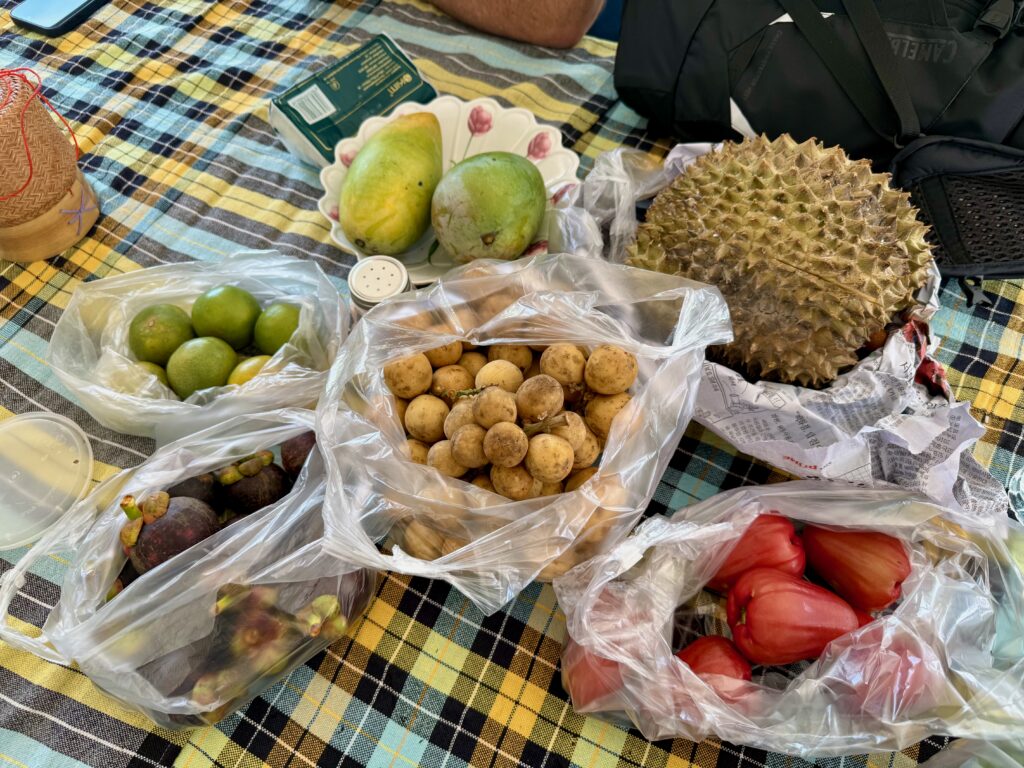
Our friend and her family welcomed us the way Isan families do — which is to say, completely. We spent the day hanging out with her husband, her son, and what felt like half the village’s worth of aunts, uncles, cousins, and neighbors. There was food, of course, mostly all local fruits (exotic to us). There is always food. There was laughter that needed no translation. And there was the simple, rare pleasure of being folded into someone’s home and history — seeing the streets where our friend rode her bike as a girl, meeting the people who raised her.
The Village School
The centerpiece of our visit was a couple of hours at the village elementary school — 21 students, kindergarten through sixth grade, all under one small roof.
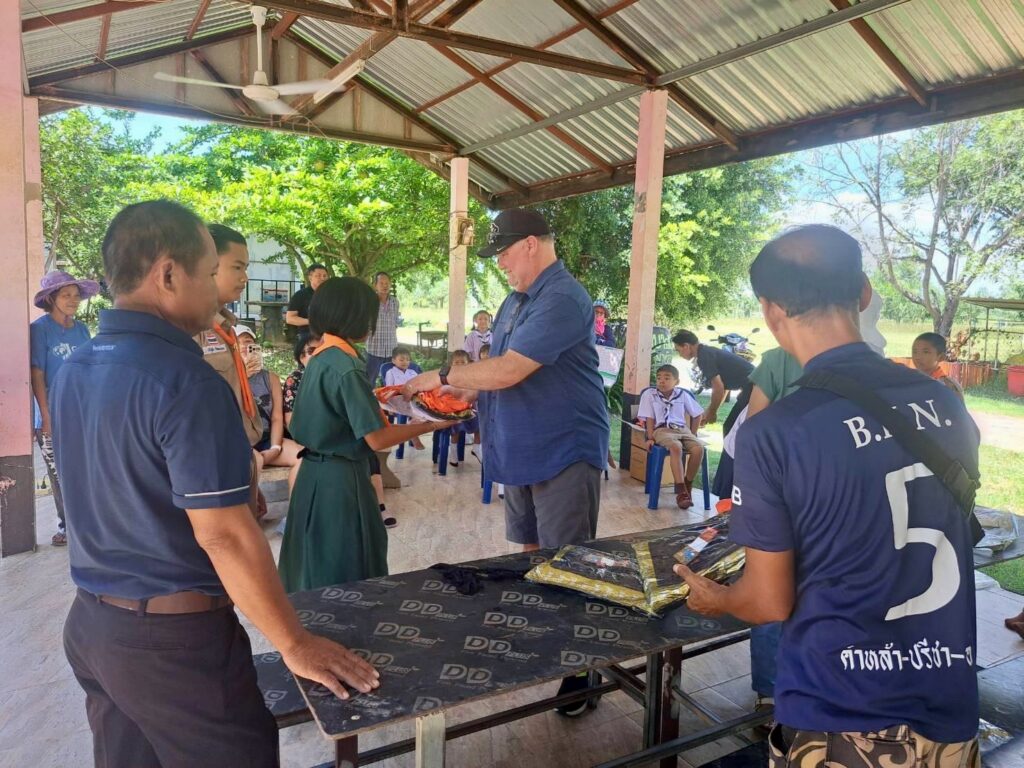
Before the trip, we’d worked with our friend to arrange a few things: new school uniforms for every child, a supply of school materials, and a special lunch brought in for the whole school. We also made a donation to help maintain and update the school building itself, so the impact would outlast our visit.
I won’t pretend we did anything heroic — the heroes are the teachers who show up every day for those 21 kids. But watching the students line up in their crisp new uniforms, giggling and proud, and then sitting down to share lunch with them? That was the single best couple of hours of the entire trip. Thirty years of marriage teaches you what actually matters, and it looks a lot like a room full of first graders grinning over a special lunch.
If you travel with any regularity, I’ll offer this gently: find a way to give back somewhere along the route. It costs surprisingly little and returns more than any five-star suite ever could.
The Durian Detour
Now, a confession: in all our years of travel, we had never tried durian. The “king of fruits” has a reputation — beloved by millions, banned from hotels, famously pungent — and we’d always found a reason to pass.
Not this time. Because this region is home to the world-renowned durian of Si Sa Ket, grown in the mineral-rich volcanic soil that makes it prized across Thailand and beyond. When in the durian capital, you eat the durian.
The verdict? The smell wasn’t that bad this time as the fruit wasn’t fully ripe with the season, but the fruit itself — rich, custardy, sweet in a way that has no real comparison — genuinely surprised us. My wife understands the devotion now. I remain slightly less converted, but we both agree: trying your first durian in Si Sa Ket is like drinking your first champagne in Champagne. Do it at the source.
Two Nights, One Full Heart
On the morning of the third day, we boarded an early Thai Airways flight out of Ubon, bound for the mountains of the north. Sisaket gave us no infinity pools and no sunset cocktails — and yet it gave us the richest days of the trip. A village called Small Lotus, a school full of big smiles, a friend’s family that became a little bit ours, and one unforgettable fruit.
Next stop: Chiang Mai, where the pace picks back up and the scenery turns green and vertical. Stay with us.
— Part Three coming soon.