
Dragonfly Travel — 30th Anniversary Series
We landed at Chiang Mai International just after one in the afternoon, an easy eighty-minute hop from Bangkok on Thai Airways. The north announced itself immediately. The air felt lighter. The mountains stood green and close on every horizon. And thirty minutes up the Mae Rim–Samoeng Old Road, past roadside orchid farms and coffee stands, the car turned into the gates of the Four Seasons Resort Chiang Mai.
Thirty years of marriage, and this was our first Four Seasons. We had been saving it.
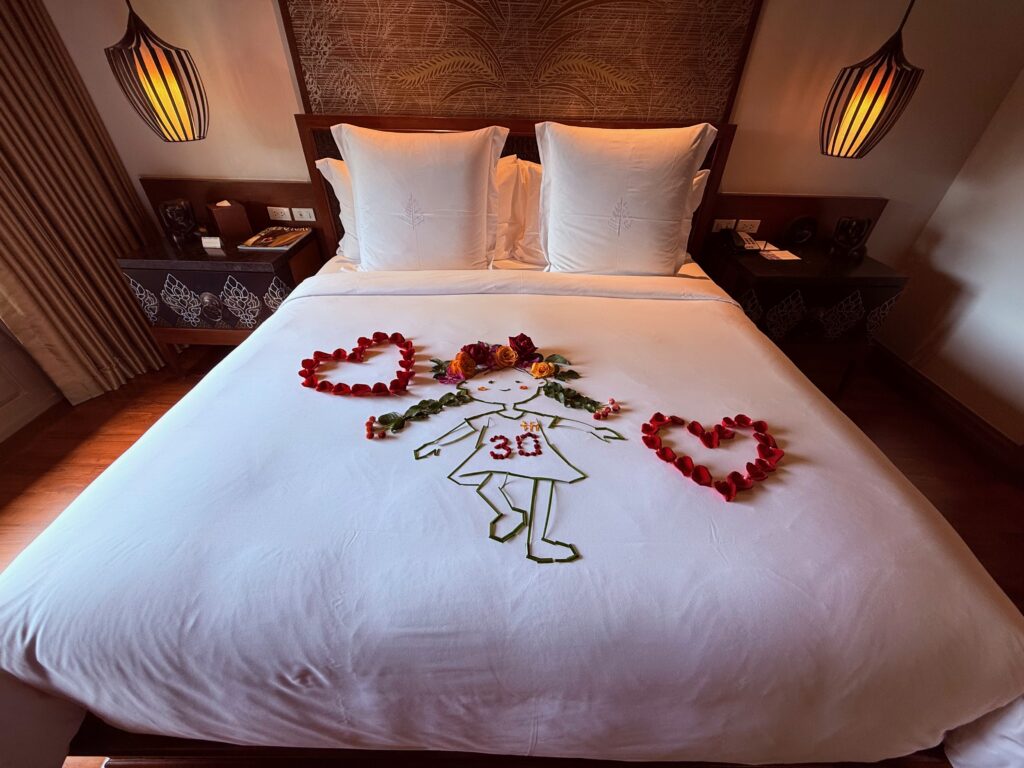
The Resort That Ruins You
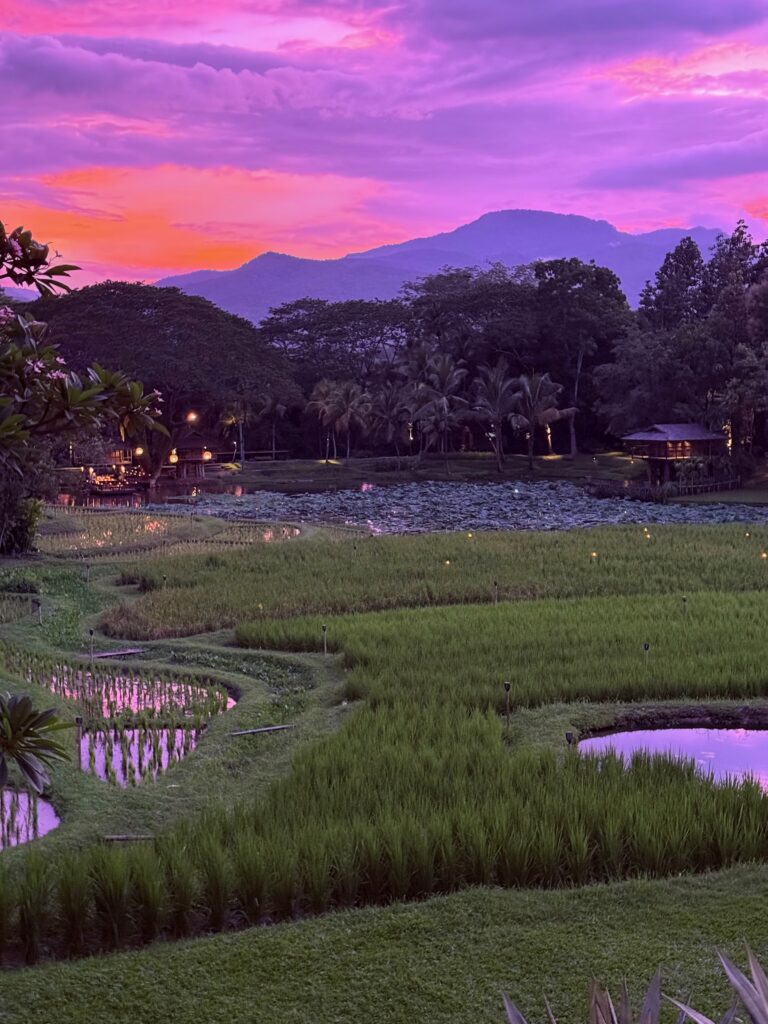
Nothing prepares you for the first view. The resort sits in a valley of working rice terraces, and the pavilions step down the hillside toward water buffalo grazing in the paddies below. Staff plant and harvest the rice year-round. It is not decoration. It is a farm that happens to have one of the finest hotels in Asia built above it.
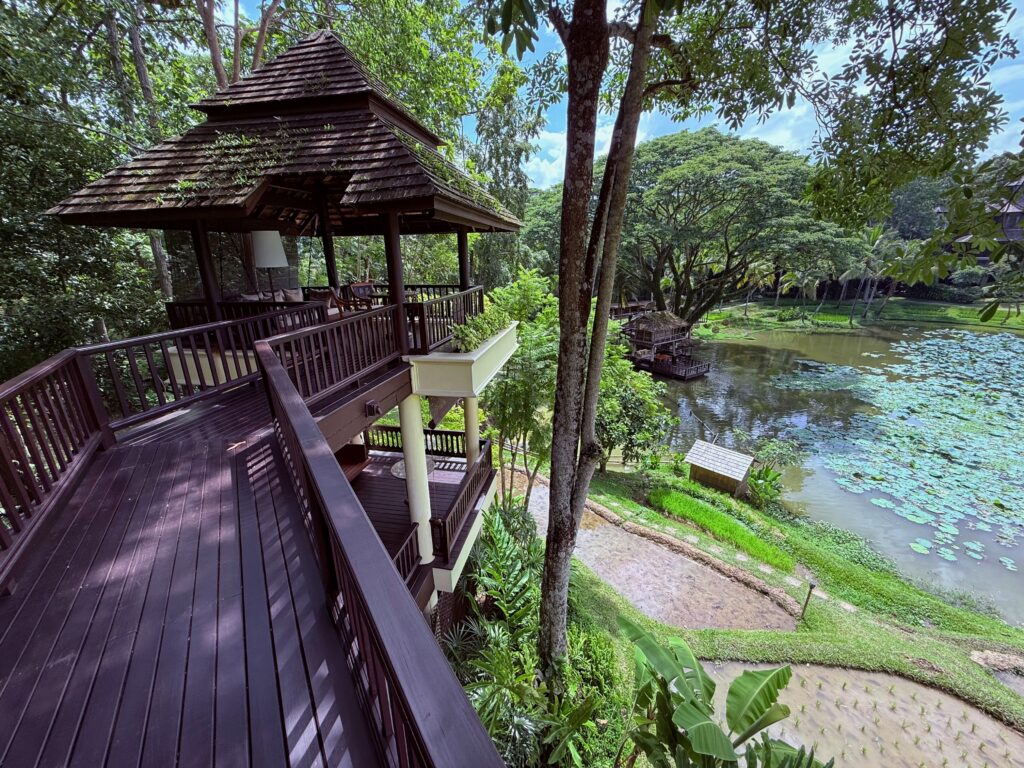
Our Upper Rice Terrace Pavilion looked straight out over the fields. Every morning we opened the shutters to mist burning off the paddies and the sound of a gong drifting up from the valley floor. Every evening we watched the light go gold, then rose, then dark, from a private sala with nothing to do but sit there and be married.
We had three nights and two and a half days. We spent them shamelessly.
Terraces delivered the northern Thai cooking that made us understand why Lanna cuisine deserves its own conversation — khao soi with crisp noodles piled on top, sai ua sausage fragrant with lemongrass and kaffir lime, nam prik ong served with vegetables pulled from the resort garden. The Pavilion turned dinner into ceremony. Lunch by the infinity pool, with the paddies below and the mountains beyond, became a daily habit we did not fight.
And the spa. A traditional Thai massage in a riverside pavilion, with the sound of moving water and absolutely no reason to hurry, is the single best thing we did for ourselves on this entire trip. Book it for your first afternoon. You will want the second one.
Temples After Dark
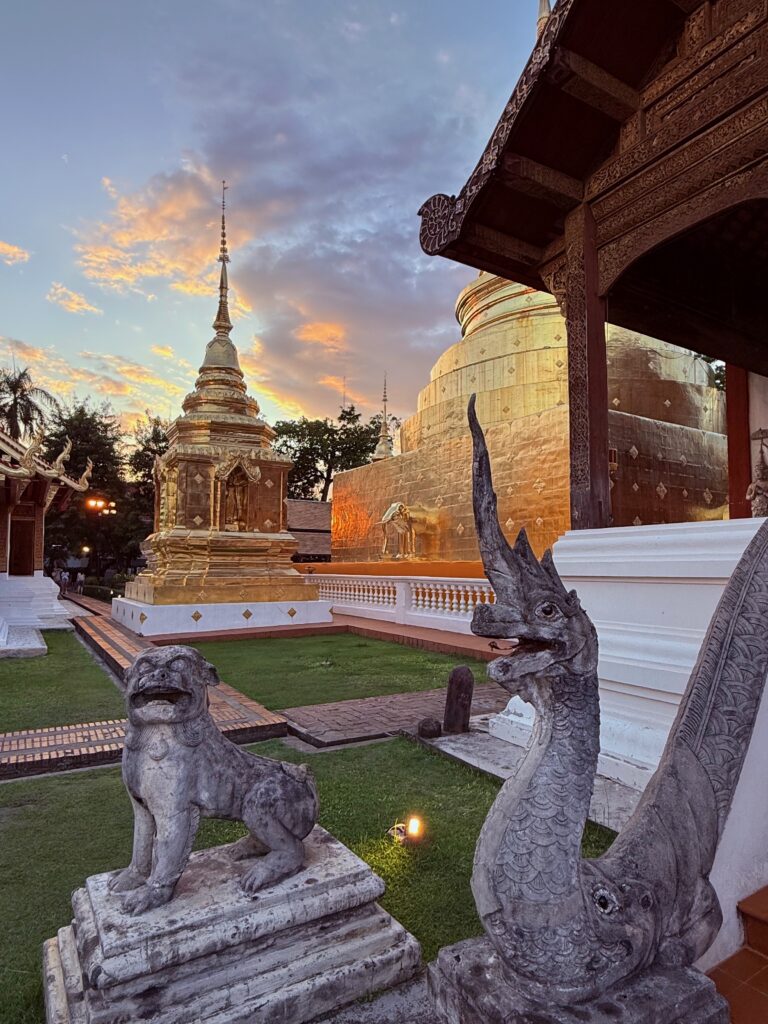
On our first evening we traded the valley for the city. Our guide from WanderSiam met us at the Thapae Gate, and for two and a half hours we bounced through the Old City in a tuk tuk with the sides open and the warm night rushing past.
Chiang Mai’s temples deserve daylight. They deserve dark more.
At Wat Chedi Luang, we stood beneath a fifteenth-century chedi that once rose over eighty meters before an earthquake took its crown. Floodlit from below, the ruined stupa looked less like a monument and more like a mountain someone had carved. Elephants in weathered stone guard its base. We were nearly alone with it.
Wat Phra Singh glowed gold at the end of a lantern-lit avenue, its Lanna rooflines stacked like folded paper. Monks moved quietly through the courtyard. Nobody rushed us.
Then our guide fed us. Street food in Chiang Mai after dark is an argument you lose gracefully — grilled pork skewers, sticky rice in bamboo, mango and coconut cream for dessert. We ended at the Chiang Mai Night Bazaar on Changklan Road, where the haggling is friendly, the silver is real, and Theresa found a hand-woven indigo scarf she has not stopped wearing since.
Seventy dollars for two people. Best value of the trip.
The Elephants
The van came for us at 8am.
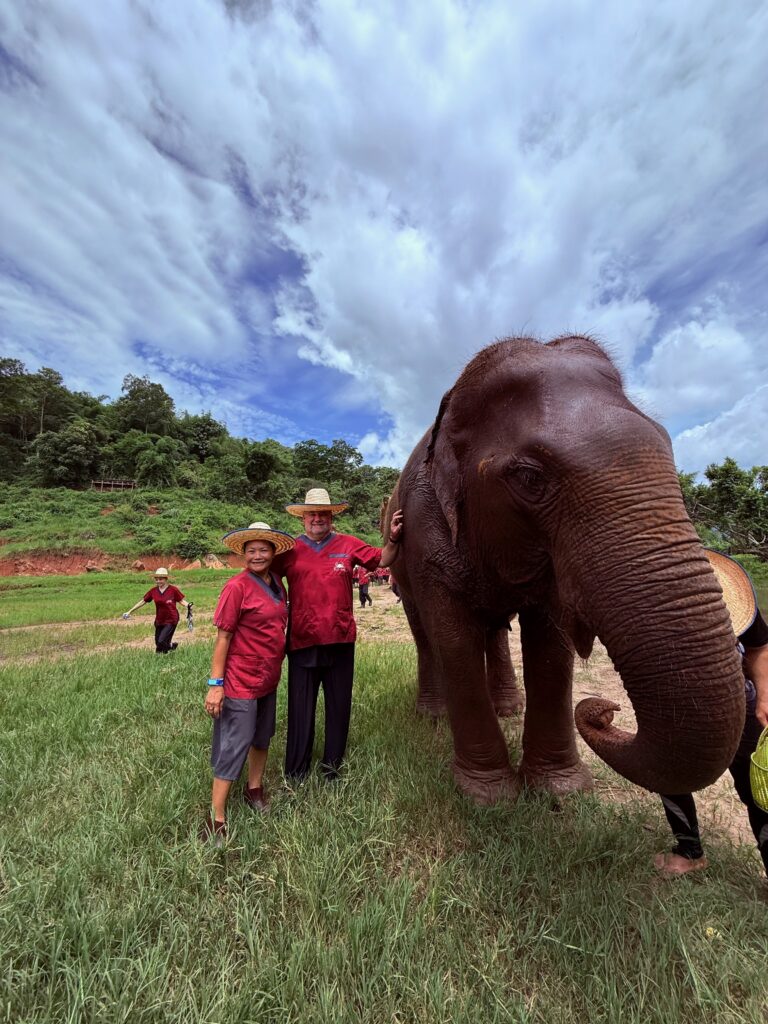
The Ran-Tong Save & Rescue Elephant Centre sits north of the city, and it does not offer rides. That mattered to us. What it offers instead is a half-day inside the daily life of rescued Asian elephants — animals pulled from logging camps and tourist trekking operations and given a place to simply be elephants.
They put us in mahout-style Karen clothing, indigo and rough-woven, and walked us into the field.
You have not understood scale until an animal the size of a truck accepts a banana from your hand with a trunk that is somehow both delicate and completely uninterested in your opinion. They ate everything. They wanted more. One matriarch worked out that I was a soft touch within about ninety seconds and followed me for half the morning.
Then we walked them to the river and bathed them. Buckets, brushes, mud, and roughly forty gallons of water redistributed onto us by an elephant who had clearly done this before and found it hilarious.
And then there was the baby.
Two months old. Waist-high. Fuzzy, in the way nobody warns you about, with a trunk she had not yet figured out how to operate and a mother who kept one eye on her at all times. She barreled around her enclosure until finding her caretaker’s lap.
I have been writing about travel for a long time. I do not have a sentence for it. We drove back to the resort mostly quiet.
What We Would Add
Two and a half days is not enough. If you have more:
- Doi Suthep — the mountaintop temple above the city, best at sunrise, 306 steps up a naga staircase.
- Doi Inthanon National Park — Thailand’s highest peak, waterfalls, twin royal pagodas, and cool air.
- The Sunday Walking Street on Rachadamnoen Road — better than the Night Bazaar, if your dates line up.
- A cooking class. Northern Thai cooking is its own tradition. Learn to make khao soi and you will chase it for years.
- Mae Rim’s orchid and butterfly farms — ten minutes from the resort, and worth an hour.
Leaving
We checked out Sunday at noon and flew down to Bangkok on the 12:00 to Don Mueang. Chiang Mai gave us mountains, temples in the dark, and an elephant calf asleep against my wife’s leg on our thirtieth anniversary trip.
Bangkok would give us something else entirely — a river, a palace, and a long-tail boat through the canals of a city that never once slowed down for us.
Part Four: Bangkok, the Chao Phraya, and the end of a very long road.
The Four Seasons Resort Chiang Mai stay was booked through American Express Fine Hotels + Resorts.