
The final installment of our 30th anniversary journey through Thailand. If you’re just joining us, start with Part One: Hua Hin, then Part Two: Sisaket and Part Three: Chiang Mai.
There is a particular kind of quiet that settles over you at the end of a long trip. Not exhaustion exactly — something closer to fullness. We felt it on the short hop from Chiang Mai down to Don Mueang International Airport, an hour in the air with the northern hills flattening out beneath us into the endless green of the central plains. Twelve days behind us. Three more ahead. And then home.
Bangkok was always going to be the exclamation point.
Arriving at the River
The car from the airport crossed the city in that slow, patient Bangkok way — traffic breathing rather than moving — and then turned down Charoen Krung Road, and suddenly the buildings opened up and there was the Chao Phraya, wide and brown and busy, longtail boats throwing white wakes across it in every direction.
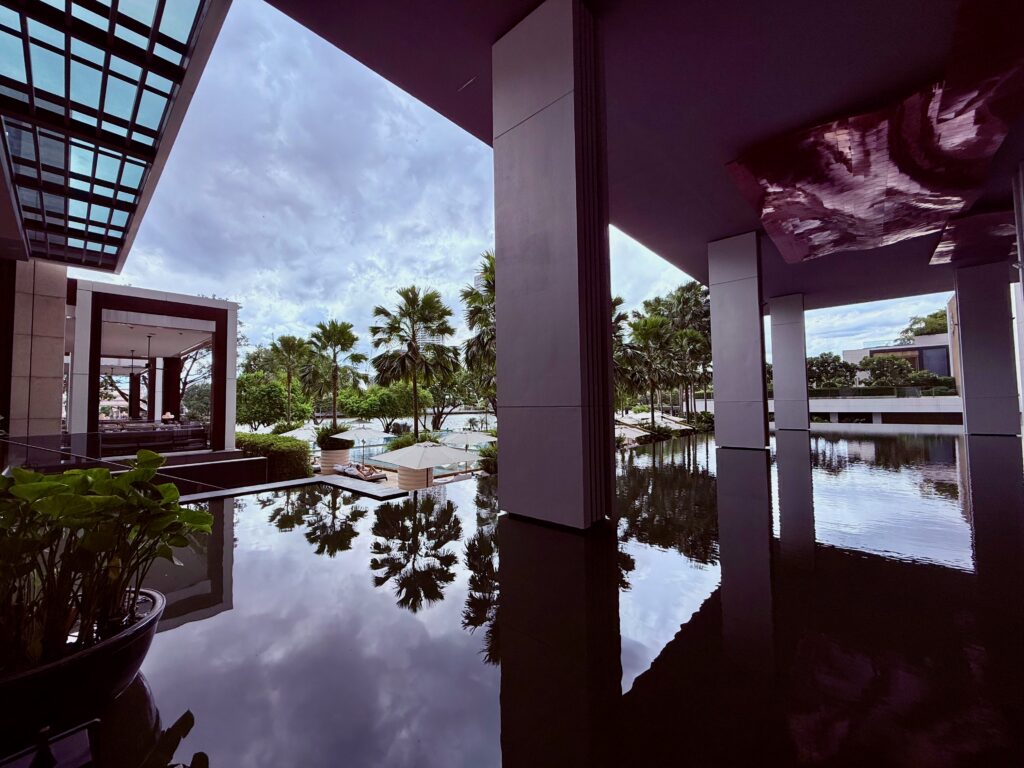
Four Seasons Hotel Bangkok at Chao Phraya River does not announce itself the way a city hotel usually does. There is no grand porte-cochère jammed against a boulevard. Instead you arrive through a series of courtyards and water gardens, past reflecting pools and old trees, and by the time you reach the lobby you have somehow forgotten you’re standing in a metropolis of eleven million people. The property is built as a set of low pavilions stepping down toward the water, and the whole thing is oriented around the river the way a sunflower orients toward light.
Last year the World’s 50 Best Hotels named it number two on the planet. The judges said it feels “closer to a resort than a city hotel.” Standing in that lobby with a cold towel in one hand and the river sliding past the windows, I understood exactly what they meant. (Bangkok, incidentally, put three hotels in the global top ten. This city is having a moment.)
We had asked, when we booked, for the highest floor available with a good view of the water — and mentioned it was our 30th anniversary. Thailand had been generous with us for two weeks straight, and it was generous again. We opened the curtains, and there was the whole river bending away toward Wat Arun, the light going gold on it.
We had three nights. We had decided, somewhere around Chiang Mai, that we would spend them properly — which is to say slowly.
The First Night: Italian on the Chao Phraya
We didn’t leave the property that first evening. We didn’t want to.
Dinner was at Riva del Fiume, the hotel’s Italian room, which sits right on the water with the boats going by outside the windows. Northern Italian cooking in the middle of Southeast Asia sounds like a strange choice on your last leg of a Thailand trip. It wasn’t. After two weeks of glorious, relentless Thai food — and I mean that, we ate extraordinarily well — there is something restorative about handmade pasta and a bottle of Barolo and a room that doesn’t ask anything of you.
Afterward we walked down to BKK Social Club, the hotel’s bar, which is regularly ranked among the best in Asia and looks like a Mexico City grand café that got lost and washed up on the Chao Phraya. Leather, brass, a long marble bar, a bartender who takes the craft seriously. We had one drink each and went to bed early, because the next day was going to be a big one.
The Full Day: Palace, Temples, and the River
We had booked a private full-day Bangkok city tour — guide, driver, all entrance fees, and an hour on a longtail boat through the canals. If you take one piece of advice from this post, take this one: in Bangkok, hire the guide. The city is enormous, the heat in late June is not negotiable, and the historical layers at these sites go far deeper than a placard can carry.
Our guide met us in the lobby at eight in the morning.
The Grand Palace first, before the worst of the day’s heat. Nothing prepares you for it. It’s not a building, it’s a walled city of buildings — gold leaf and mirrored glass and porcelain mosaic stacked on top of each other until the whole complex seems to vibrate in the sun. Inside sits Wat Phra Kaew and the Emerald Buddha, carved from a single block of jade, small and dark and utterly still in the middle of all that glitter. The king changes its robes three times a year with the seasons. Nobody else is permitted to touch it.
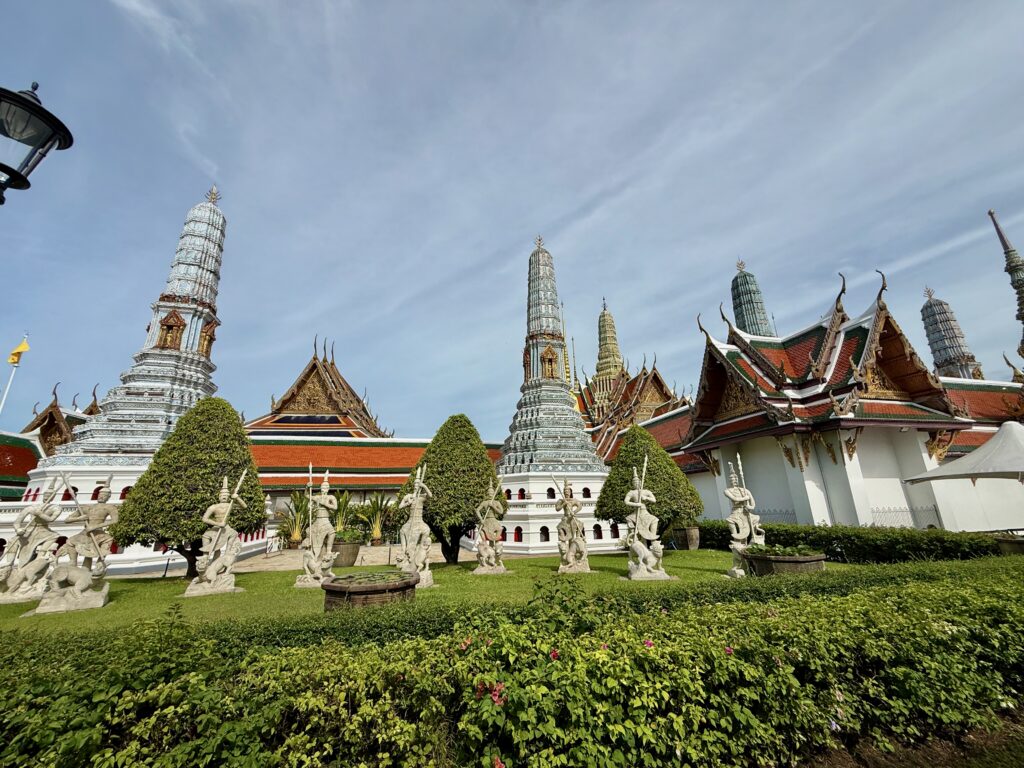
A note for anyone going: the dress code is real and it is enforced. Shoulders and knees covered, closed shoes, no exceptions. They’ll sell you a cover-up at the gate, but you’ll pay for the privilege and you’ll be uncomfortable all morning. Dress correctly before you go.
Wat Pho came next — the Temple of the Reclining Buddha, 150 feet of gilded serenity lying on its side in a hall that barely contains it. You walk the length of it and try to take a photograph and fail, because there’s no angle that holds the whole thing. Wat Pho is also the birthplace of traditional Thai massage, and the school still operates on the grounds. We ran out of day before we could get on a table, which I regret.
Then the boat.
We crossed the river and worked our way into the khlongs, the canals of Thonburi, and the city changed completely. Wooden houses on stilts leaning over the water. Laundry lines. Kids jumping off docks. An old woman selling noodles out of a boat. Monitor lizards the size of dogs sunning themselves on the banks. Bangkok used to be called the Venice of the East, and out there — thirty minutes from a hotel with a two-hundred-dollar breakfast — you can still see the city that name was given to.
We came back out onto the Chao Phraya and pulled up at Wat Arun, the Temple of Dawn, its central spire encrusted in broken Chinese porcelain — ballast from old trading ships, pressed into the stucco by hand. Up close it looks like a mountain made of teacups. We climbed the steep steps partway up and looked back across the river at the Grand Palace shimmering in the afternoon light, and Theresa said, quietly, that she was glad we’d waited thirty years to do this properly.
ICONSIAM, and a Bar You’ve Seen Before
The next day we slowed down.
Breakfast at the hotel, a long morning by the water, and then across the river to ICONSIAM — which is not really a mall so much as a small country with escalators. Luxury flagships on the upper floors, absolutely, but the reason to go is SookSiam on the ground level: an indoor recreation of a floating market representing all 77 Thai provinces, with vendors selling regional food and crafts under a canopy of woven roofs. It’s touristic, yes. It’s also delicious, air-conditioned, and a fantastic place to solve your entire souvenir list in ninety minutes. We took the hotel’s shuttle boat over, which is free and about four minutes long and much more pleasant than a taxi.
Late afternoon we came back for tea at The Lounge, watching the barges push upriver.
And then we went out for the two bars we’d promised ourselves.
First, the Bamboo Bar at the Mandarin Oriental — a short ride up the same riverbank. Opened in 1953, it is the oldest jazz bar in Bangkok and one of the best in the world, all rattan and leopard print and low light, with a live band playing standards. It’s also the only Bangkok hotel bar that appeared in The White Lotus, Season 3 — the room where Rick meets Frank. Sitting in it, you understand why the location scouts picked it. The place has an atmosphere you cannot build; it has to accumulate over seventy years.
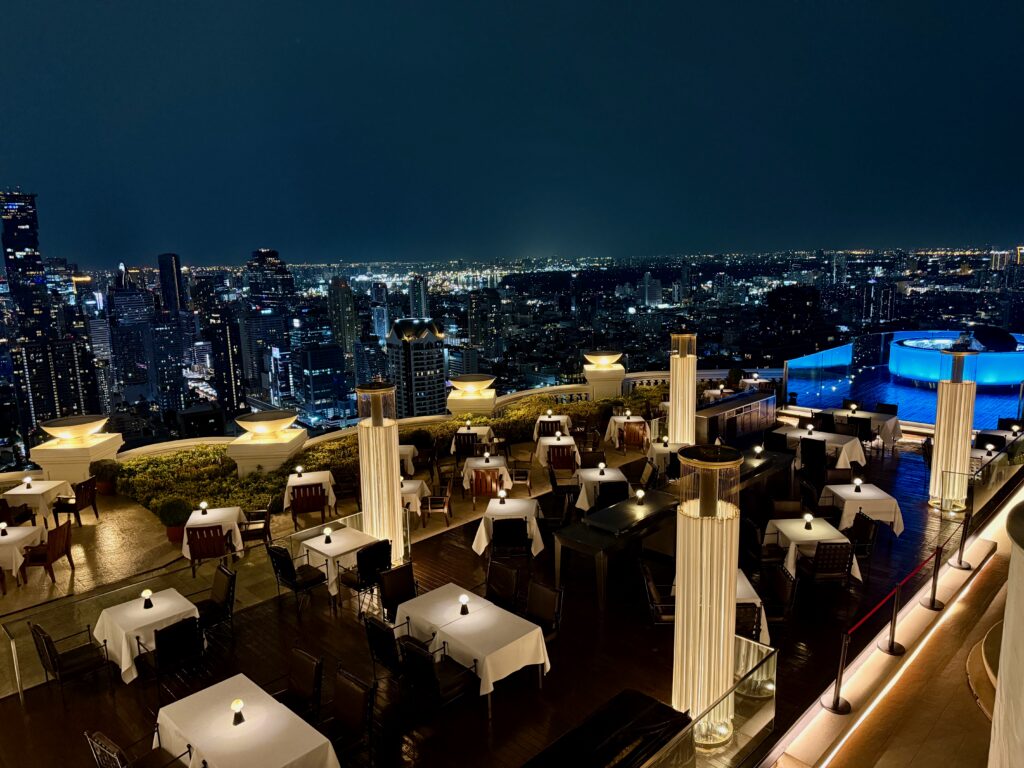
Then, because you have to, the Sky Bar at Lebua State Tower — 820 feet up, sixty-three floors above Silom Road, an open-air circular bar cantilevered out over nothing at all with the Chao Phraya unspooling below in the dark. This is the rooftop from The Hangover Part II. They will happily sell you a Hangovertini, but we passed on this tourist moneypit for something more like us. There is a moment when you first step out onto that terrace and the city drops away beneath your feet — twenty million lights, all the way to the horizon — and whatever you paid stops mattering.
Long trousers and closed shoes for the men. They’ll turn you away otherwise.
Leaving
Our car came at half past four in the morning. Bangkok at that hour is a different animal — empty expressways, monks already walking with alms bowls, the sky just beginning to go gray behind the towers. Twenty-eight hours later we were in Herndon, in our own bed, with two very enthusiastic dogs.
Fifteen days. Four destinations. A beach resort in Hua Hin, a village school in Isan, an elephant sanctuary in the hills above Chiang Mai, and a palace on a river in Bangkok. We went for our thirtieth anniversary, and what we found — over and over, in every one of those places — was ordinary human kindness offered without calculation. That’s the thing about Thailand that no photograph carries home, the true heart of its people.
Thirty years in, wehave learned that the trip is never really the point. The point is who you’re standing next to when the light hits the temple.
Here’s to the next thirty.
If You Go: Bangkok
Where we stayed Four Seasons Hotel Bangkok at Chao Phraya River — 300/1 Charoen Krung Road. Book a river-view room and ask for a high floor; the view is the entire point. We booked through American Express Fine Hotels + Resorts, which included daily breakfast for two, a property credit, and an upgrade at check-in. If you hold a card with FHR access, use it here.
What we did
- The Grand Palace & Wat Phra Kaew — open 8:30 AM–3:30 PM, ฿500. Go early. Dress code strictly enforced.
- Wat Pho — Temple of the Reclining Buddha, open daily 8:00 AM–6:30 PM. The on-site massage school is worth building time for.
- Wat Arun — Temple of Dawn, open daily 8:00 AM–6:00 PM (last entry 5:30 PM). Best reached by river.
- A private full-day guided tour with longtail boat through the Thonburi canals. We used a local operator booked through Viator; hotel pickup and all entrance fees included.
- ICONSIAM — free shuttle boat from the hotel pier. Head straight for SookSiam on the ground floor.
Where we drank
- BKK Social Club — at the Four Seasons. One of Asia’s best bars, and you don’t have to leave the building.
- The Bamboo Bar — Mandarin Oriental. Live jazz nightly. Reserve ahead.
- Sky Bar at lebua — 63rd floor. Sunset is the move; arrive by 6:00 PM for a rail spot. Dress code enforced.
What we’d add with more time
- Jim Thompson House Museum — the teak home of the American who revived Thai silk, and then vanished in Malaysia in 1967. A genuinely great museum.
- Wat Saket, the Golden Mount — 300 steps to the best free view of old Bangkok.
- Chatuchak Weekend Market — 15,000 stalls. Weekends only. Go at opening.
- Yaowarat, Bangkok’s Chinatown — the greatest street food corridor in Asia after dark.
- Bang Krachao, the “green lung” — bicycle through jungle and stilt villages fifteen minutes from downtown.
- Thai Airways and Bangkok Airways both connect Bangkok to the islands in under 90 minutes, if you want to extend.
When to go We traveled in late June — green season. Expect heat, humidity, and a hard afternoon downpour most days that clears in an hour. Fewer crowds and lower rates are the trade. November through February is drier and cooler, and priced accordingly.
Planning a trip to Thailand? This is exactly the kind of itinerary we build at Dragonfly Travel — soft adventure, cultural immersion, and luxury that earns its price. Get in touch.
Leave a Reply